
Criminal Court Cases in Cortland County
Cortland County Court alone conducts local felony trials. It also hears criminal appeals from Cortland City Court and the town and village justice courts. County Court, City Court, and justice courts share authority over misdemeanors and lesser offenses. A felony may begin with arraignment or a preliminary proceeding in a local court, then move to County Court after grand-jury action. That division is why one Cortland County court case can leave entries at more than one clerk's counter.
The County and Supreme Courts sit at 46 Greenbush Street. County Court papers are filed with the Court Clerk in Suite B5, and pending criminal inquiries go to the chief clerk's office at 607-218-3320. The public counter is open Monday through Friday, 8:30 a.m. to 4:30 p.m. Cortland City Court, at 25 Court Street, handles city misdemeanors, violations, local ordinances, and preliminary felony matters. The court that heard the matter remains the best source for its complete public file and any certificate of disposition. Court security requires courthouse visitors to pass through a magnetometer.
Cortland County Clerk Terminal Searches
Cortland County criminal files do not appear in the county's public SearchIQS land-record system. The County Clerk's criminal-actions instructions say unsealed files can instead be searched on a public computer terminal in Suite B5. A request must identify the name and the span of years to search. Processing can take up to 24 hours, and the office will not accept the search request or release results by telephone.
The local search costs $5 per name for each two-year period. A broad span therefore requires more than one paid interval. Mailed searches need a self-addressed stamped envelope. Copies cost $0.65 per page with a $1.30 minimum; certified copies cost $1.25 per page with a $5 minimum. The clerk accepts cash, check, money order, and credit card with a 2 percent convenience fee, but not American Express. Those fees buy local clerk work, not a statewide rap sheet.
The official Cortland County Court source shows the court and clerk information captured below.
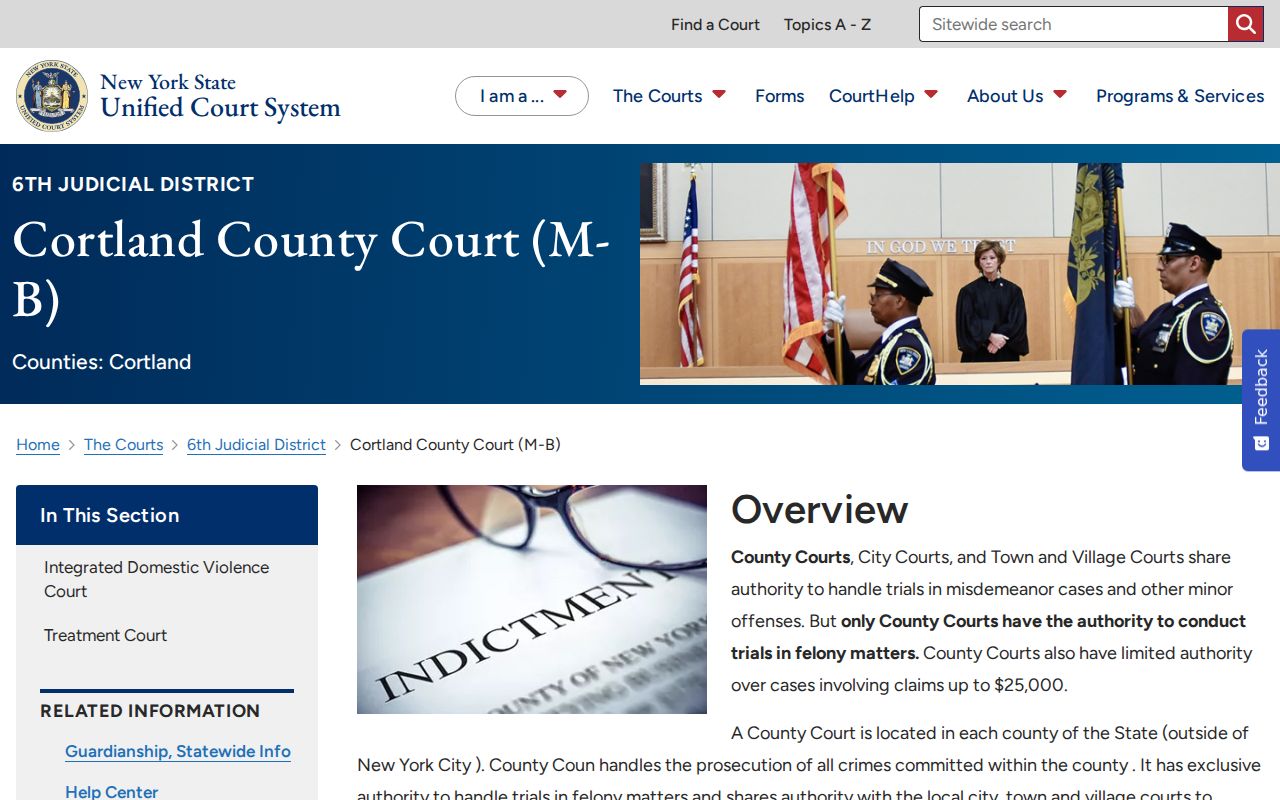
The image reinforces the distinction between a public court contact and a broad commercial-style name search.
Cortland County Case Record Searches
Start with the court and the type of answer needed. WebCriminal can help locate a public criminal docket or calendar entry. The local clerk can retrieve a Cortland County felony file and certify a disposition. OCA Criminal History Record Search, or CHRS, is a separate statewide exact-name and date-of-birth product. It is not the court file and does not replace a request to the originating clerk.
- Identify the court from the appearance ticket, docket number, charging paper, or known case location.
- Check WebCriminal for a public defendant, case, or calendar result before calling the clerk.
- For a County Court file, request the name and two-year search span at Suite B5. For a local case, use the issuing City, Town, or Village court.
- Use OCA CHRS only when its statewide exact-match court-history product fits the question.
- Ask the originating clerk for copies or a certificate of disposition when proof of the final outcome is needed.
CHRS uses the fields below. Each alias and each alternate date of birth counts as a separate search.
| CHRS field | Type | Required | Notes |
|---|---|---|---|
| Requester name and contact | Text and email | Yes | Mail requests include address and phone; email is needed for email delivery |
| Subject full name | Text | Yes | Exact match; aliases are searched and charged separately |
| Subject date of birth | Date | Yes | Exact match; alternate dates are separate searches |
| Return method | Choice | Yes | Email or mail; mail delivery requires a stamped return envelope |
Cortland Court Files Versus CHRS
The current CHRS fee is $95. Online searches with no result return in real time, while a possible match is reviewed and normally emailed the next business day during service hours. CHRS covers reported open, pending, and conviction data from County, Supreme, City, Town, and Village courts across New York. It excludes sealed matters, federal cases, noncriminal violations, Family Court matters, qualifying cannabis expungements, and other protected categories.
Town and village reporting has historic gaps. Dispositions are absent for May 1991 through 2002 and limited for 2002 through 2007; all town and village courts have reported since May 2007. CHRS relies on electronic court transmissions and is not fingerprint based. A no-result response cannot prove that no local incident, sealed case, federal matter, or out-of-state record exists. It also cannot issue a certificate of disposition. Only the court that decided the case can do that.
Note: An older local court page shows a former CHRS fee, but the current statewide OCA page controls the present price.
What a Criminal Case File Contains
A Cortland County criminal case file follows what prosecutors filed and what the judge did. It is more precise than an intake charge. The exact contents vary by court and case, but the public docket commonly organizes the fields below. Grand-jury material, sealed documents, youthful-offender records, and protected victim data are not part of ordinary public access.
| Case Number and Court | Identifies the venue and links filings to one court matter |
|---|---|
| Charging Document | Shows the complaint, information, or indictment filed with the court |
| Docket Entries | Records appearances, motions, rulings, and other filed events |
| Hearing Dates | Lists arraignment, calendar, conference, trial, or sentencing dates when public |
| Disposition and Judgment | States dismissal, plea, verdict, or other final result |
| Sentence and Conditions | Records the court's sentence and public terms attached to the judgment |
Read charge and outcome separately. A booking charge can change before the prosecutor files the case, and a filed count can be reduced or dismissed. “Pending” describes status, not guilt. “Disposed” means the court reached an outcome, but the docket or certificate is needed to learn what that outcome was.
Cortland Criminal Court Calendar Parts
Cortland City Court uses named parts that make its docket more local than a generic case-stage list suggests. Its criminal calendar procedures include arraignment, calendar call, pretrial and discovery compliance, sentencing, DWI, domestic violence, and Drug Court sessions. After arraignment with counsel, unresolved matters may move into scheduled 15-minute calendar-call and discovery slots. Clerks send counsel, or a self-represented defendant, a packet that includes motion deadlines.
At pretrial conference, a Cortland County case may resolve through a plea or be set for trial. Cortland City Court arraignments are scheduled Monday mornings. Criminal and traffic all-purpose terms are held Monday, Wednesday, and Friday mornings. DWI Part meets on the second and fourth Fridays, while Domestic Violence Part meets on the first and third Fridays. Those patterns help explain a docket's next appearance, but the current notice from the clerk controls.
Criminal Case Stages in Cortland County
A criminal case begins when an accusatory instrument is filed, not merely when an arrest occurs. The court conducts arraignment and advises the accused of the charge. A felony may involve a preliminary hearing and grand-jury review before County Court. The parties then address discovery, motions, and plea discussions. An unresolved case proceeds to a bench or jury trial. A plea or verdict leads to disposition and, after a conviction, sentencing. An appeal may follow.
Case flow: Charges Filed › Arraignment › Pretrial › Plea or Trial › Disposition › Sentencing
Cortland County Court also hears criminal appeals from local justice courts and City Court. The appellate role is another reason the venue shown on a later record may differ from the court where the case first appeared.
Cortland Treatment Court Case Records
The Cortland County Drug Treatment Court meets Mondays at the courthouse. It serves nonviolent defendants with substance-use disorder through assessment, treatment referral, intensive supervision, toxicology testing, and monitoring. Judge Elizabeth A. Burns presides, and the resource coordinator and case manager line is 607-221-1841.
Participation does not turn the case into a separate arrest record. Court orders, appearances, compliance decisions, and the final disposition remain tied to the criminal matter, subject to the same sealing and confidentiality rules that govern the file. Cortland also has City Court Domestic Violence Court and County Integrated Domestic Violence Court. Readers should use the docket and originating clerk to understand which part handled a specific case.
Access Rules for Case Records
New York court records are open only to the extent allowed by law. Judiciary Law §255 directs clerks to search and certify records upon lawful request and payment. CPL §160.50 seals records after a termination in favor of the accused, subject to stated exceptions. Youthful-offender records are confidential, and grand-jury material is protected.
Clean Slate automatic sealing under CPL §160.57 and discretionary sealing under CPL §160.59 can also change what a public search returns. A missing public result may reflect sealing, an older local record, a spelling or date mismatch, or delayed reporting. It should not be treated as proof that no case ever existed. Ask the proper clerk about a file that should be present, and use a seal-verification request when the issue is whether a court order reached the agencies.
Older Cortland County Court Cases
Older and non-electronic Cortland County records require the originating court. The official county justice-court directory lists clerks and contacts for Cincinnatus, Cortlandville, Cuyler, Freetown, Harford, Homer, Lapeer, Marathon, Preble, Scott, Solon, Taylor, Truxton, Virgil, and Willet. Those courts keep their own misdemeanor, violation, preliminary-felony, and bench-warrant files.
For a McGraw matter, Cortlandville Town Court is a practical first lead, but the ticket or case paper should confirm jurisdiction. For a Homer matter, distinguish Homer Town Justice Court from County Court. When the purpose is to connect a filed case to an earlier arrest, use the dedicated Cortland County Arrest Search for the agency and custody channels, then return to the court clerk for the legal outcome.